


- Details
- Category: news
- Hits: 561
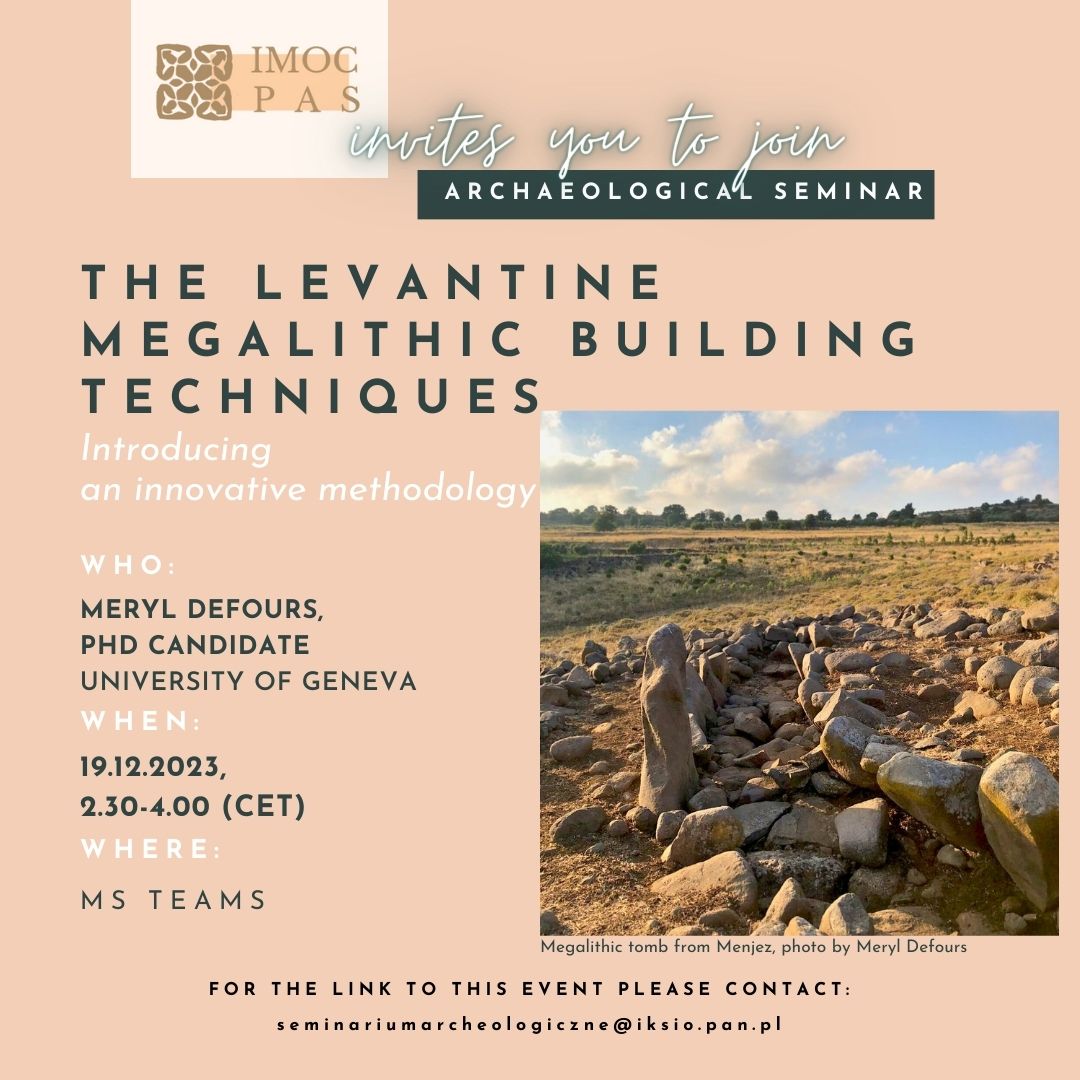
Lecture abstract:
Meryl Defour (doctoral candidate at the University of Geneva) will present an innovative methodology for studying the megalithic architecture of Menjez in Akkar, Lebanon. Their study is part of the joint project between the University of Geneva and the Institute of Mediterranean and Oriental Cultures (2022-2025), co-directed by Tara Steimer-Herbet and Zuzanna Wygnanska, entitled "MEG-A - First megalith builders in the northern Levant".
Twenty-four monuments from Menjez have been studied since 2018. The main objective is to develop a comprehensive understanding of the unique Levantine megalithic construction techniques and to re-establish the "chaînes opératoires" by determining the sequence of actions taken by the builders. This ground-breaking methodology originally developed for a study of the Western European megalithic monuments, notably in Brittany, France, has been applied and customized to suit the Levantine context, specifically focusing on the distinctive basaltic monuments of Menjez and its surrounding areas. By using photogrammetry as a tool, the researchers are able to de-construct the megalithic architecture by analysing the different components of these monuments. Moreover, it is then possible to describe monoliths according to their place within the monument and their geological and geomorphological features. Our work has led us to consider the symbolic aspect expressed in the megalithic architecture of Menjez. Employing this innovative methodology not only yields concrete answers regarding the typology of these monuments but also dramatically reshapes our perception of their construction. It establishes a precise relative chronology for the various architectural phases and, most significantly, reveals the hidden details of the raw material supply chain.
- Details
- Category: news
- Hits: 572
 Krzysztof Gutowski, MA, was awarded a grant in the NCN PRELUDIUM 22
We would like to congratulate Krzysztof Gutowski (Section for the Study of Cultures along the Silk Road, Department of Modern Cultures of Asia and Africa) on receiving funding under the PRELUDIUM 22 competition. His project, entitled “Agnihotra Ritual in the Indian Religiosity of Vedic Period”, is one of four proposals from the HS1 panel that won the favour of the experts.
For more information on K. Gutowski's project, please see here https://www.ncn.gov.pl/sites/default/files/listy-rankingowe/2023-03-14-opkit45wac/streszczenia/593973-en.pdf.
We are immensely pleased with Krzysztof Gutowski's achievement and wish him much success with his project!
- Details
- Category: news
- Hits: 561

Dr Patrycja Kozieł laureate of the MINIATURA 7 competition
We are very pleased to announce that the project of Dr Patrycja Kozieł (Division for Research on Sub-Saharan Africa, Department of Modern Cultures of Asia and Africa) entitled “Cultural memory and the Afro-Brazilian heritage in Nigeria – in search of identity” has been awarded funding under the MINIATURA 7 competition.
We would like to congratulate Dr Patrycja Kozieł and wish her much success!
A list of supported projects is available at https://www.ncn.gov.pl/konkursy/wyniki/miniatura7.
- Details
- Category: news
- Hits: 542
Dr Natalia Bahlawan laureate of the MINIATURA 7 competition
We are very pleased to announce that the project of Dr Natalia Bahlawan (Division for Research on Contemporary Islam and Arabic Culture, Department of Islamic Civilisations) entitled 'The activity of religious institutions within the confessional system in Lebanon - an introduction to study the cultural dimmension of confessionalism' has been awarded funding under the MINIATURA 7 competition.
We would like to congratulate Dr Natalia Bahlawan and wish her much success!
- Details
- Category: news
- Hits: 535
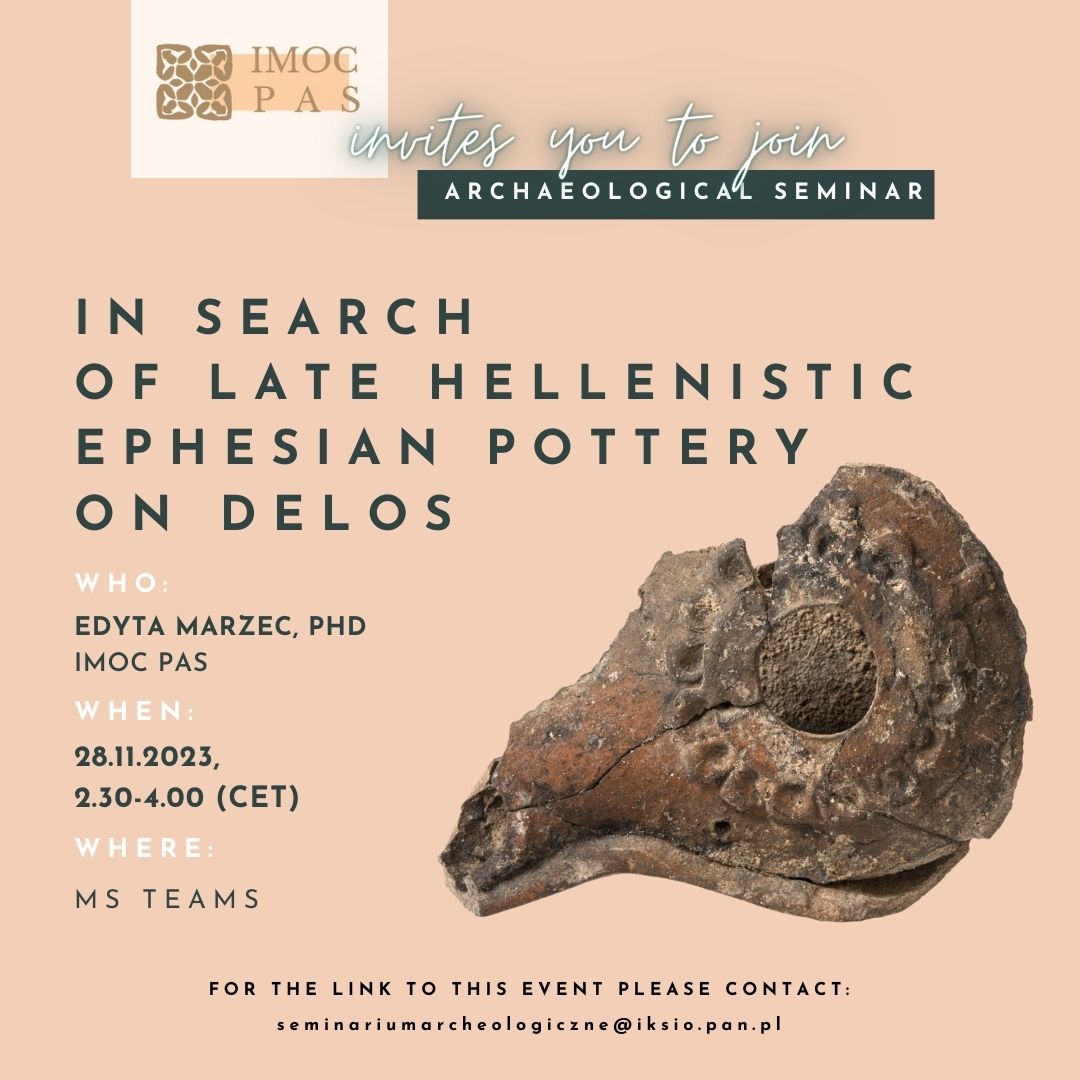
Lecture abstract:
In her talk, Dr Edyta Marzec will present her interdisciplinary study of Late Hellenistic Ephesian fine ware pottery found on Delos. In the Late Hellenistic period (the Second Athenian Domination on Delos, 167/166-88/69 BCE), Delos was a duty-free commercial hub trading goods, including fine ware pottery from all over the Mediterranean. Previous macroscopic studies of pottery from Delos indicated that fine wares produced in Ephesus were used on the island. The results of the macroscopic examinations of pottery from Aphrodision and Serapiea integrated with elemental and petrographic analyses of 31 samples confirm this suggestion. Additionally, this study shows that Ephesian fine pottery found on the island is more varied in terms of macroscopic appearance of fabric and shape than reported so far on Delos. The macroscopic variability of fabric seems to be a result of varied firing processes, including different atmospheres, temperatures as well as arrangements of vessels in kilns. The integration of the results of pottery study with other archaeological evidence indicates that the presence of Ephesian pottery on the island might be related not only with its trading role but also with the customer preferences as well as the presence of the Ephesian community on Delos.